Unveiling the Evolution of Computer Hardware: From Eniac to Quantum Computing
In the ever-evolving landscape of technology, the journey of computer hardware stands as a testament to human ingenuity and innovation. From the bulky behemoths of the past to the sleek, powerful machines of today, the evolution of hardware has been nothing short of remarkable.
The Dawn of Computing: From Eniac to Silicon Valley
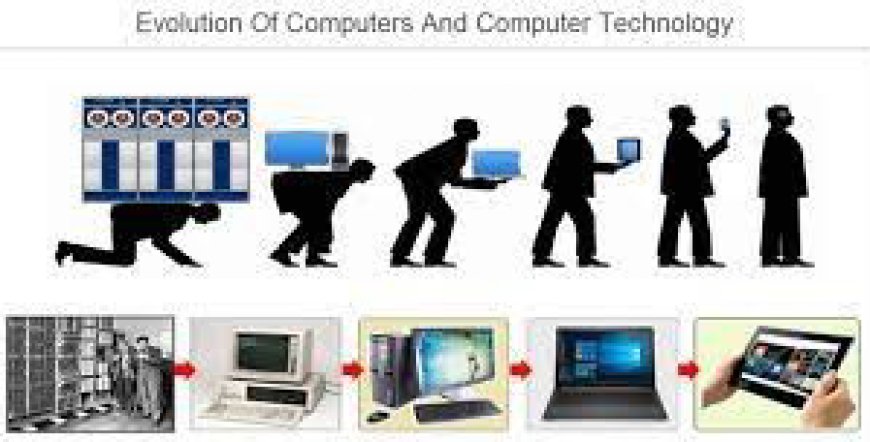
The inception of computer hardware dates back to the mid-20th century with the birth of colossal machines like the Electronic Numerical Integrator and Computer (ENIAC). Spanning entire rooms and operating on vacuum tubes, these early computers laid the groundwork for the digital revolution.
Advancements in semiconductor technology paved the way for the rise of Silicon Valley and the era of integrated circuits. The invention of the microprocessor by Intel in the 1970s heralded a new era of computing, shrinking computational power into a single chip and laying the foundation for the personal computer revolution.
From Desktops to Laptops: The Age of Mobility
As computing power continued to surge, the focus shifted towards portability. The 1980s witnessed the emergence of laptops, offering users the freedom to compute on the go. Miniaturization of components and improvements in battery technology fueled this transition, empowering individuals and businesses alike to break free from the confines of the desktop.
The Rise of High-Performance Computing: GPUs and Parallel Processing
In tandem with traditional CPUs, Graphics Processing Units (GPUs) emerged as a powerhouse for parallel processing tasks, revolutionizing fields like gaming, artificial intelligence, and scientific research. Harnessing the immense parallelism of GPUs, researchers unlocked new frontiers in fields such as deep learning, simulation, and data analytics.
Beyond Moore's Law: Exploring Quantum Computing
As the limits of classical computing are approached, the quest for alternative paradigms intensifies. Enter quantum computing—a paradigm shift that promises exponential leaps in computational power by leveraging the principles of quantum mechanics. Quantum bits, or qubits, harness the superposition and entanglement phenomena to perform computations at speeds unattainable by classical computers.
The Road Ahead: Towards a Smarter, Sustainable Future
Looking ahead, the trajectory of computer hardware points towards a future characterized by intelligence, efficiency, and sustainability. Innovations such as neuromorphic computing, optical computing, and bio-inspired architectures hold the potential to redefine the boundaries of what's possible, ushering in an era of unprecedented computational prowess.
In conclusion, the evolution of computer hardware mirrors the relentless march of human progress—driven by curiosity, fueled by innovation, and bound only by the limits of our imagination. As we stand on the precipice of a new technological frontier, one thing remains certain: the journey of computer hardware is far from over, and the best is yet to come.